
Chelsea Accumulator Betting Strategy and Odds
 Available in US
Accumulators represent betting’s ultimate temptation—the promise of massive returns from modest stakes by combining multiple selections into single bets with multiplied odds. When Chelsea plays, the temptation intensifies because their matches offer dozens of markets ripe for combination. A four-leg accumulator featuring Chelsea to win, over 2.5 goals, Cole Palmer anytime scorer, and Chelsea corners over can easily produce combined odds exceeding 10.00, transforming a ten-pound stake into a potential hundred-pound return.
The uncomfortable truth about accumulators is that they systematically favor bookmakers through compounded edge. Every selection you add multiplies both your potential return and the bookmaker’s advantage. If each individual bet carries a three percent house edge, a four-leg accumulator doesn’t carry twelve percent edge—it carries roughly eleven point five percent edge after compounding. This mathematical disadvantage means casual accumulator betting produces reliable long-term losses regardless of how carefully you select individual legs.
However, dismissing accumulators entirely ignores their legitimate strategic applications. When structured intelligently around positive expected value selections rather than arbitrary favorites, accumulators can provide entertainment value while maintaining reasonable loss rates. More importantly, certain accumulator structures exploit bookmaker pricing inefficiencies and correlation dynamics that single bets can’t access. Understanding which accumulator types offer genuine value versus which represent pure gambling transforms multi-bet wagering from hopeful lottery tickets into calculated strategy.
This guide examines Chelsea-focused accumulator strategies that actually work, explaining how to construct multi-bet combinations that minimize bookmaker edge while maximizing realistic winning probability. You’ll learn which markets combine effectively, how correlation affects accumulator value, and critically, when to avoid accumulator temptation entirely in favor of straight bets offering better mathematical expectation.
Table of Contents
The Mathematics of Chelsea Accumulators
Understanding accumulator mathematics prevents the wishful thinking that destroys most multi-bet bettors’ bankrolls. The odds multiplication that makes accumulators exciting also compounds probability in ways that dramatically reduce win likelihood.
A simple two-leg accumulator combining Chelsea to win at 1.70 with over 2.5 goals at 1.80 produces combined odds of 3.06. Calculating true win probability requires multiplying individual probabilities—if Chelsea wins sixty percent of the time and overs hit fifty-five percent, the accumulator wins thirty-three percent (0.60 × 0.55). At 3.06 odds, you need 32.7 percent win rate to break even, meaning this accumulator offers marginal positive expectation if your probability assessments are accurate.
The challenge intensifies as you add legs. A four-leg accumulator where each selection offers sixty percent probability wins just 13 percent of the time (0.60 × 0.60 × 0.60 × 0.60 = 0.13). Combined odds might look attractive at 7.50, but winning one in eight attempts barely breaks even mathematically while producing frustrating losing runs psychologically. Most bettors drastically overestimate their ability to predict four independent events correctly, leading to accumulator structures with actual win probabilities far below break-even thresholds.
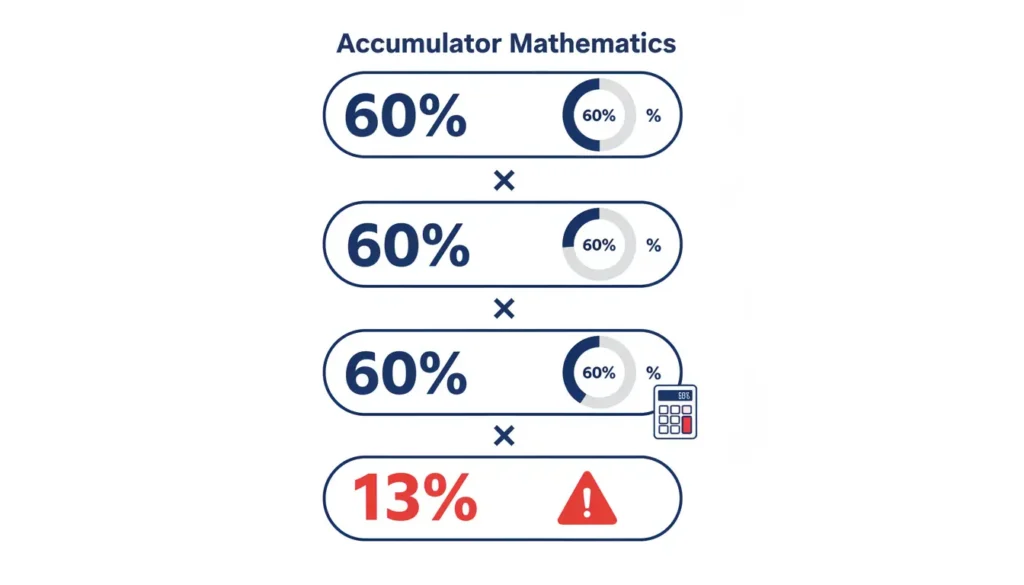
Bookmaker margin compounds viciously in accumulators. If each leg carries four percent overround, a four-leg accumulator doesn’t carry sixteen percent total margin—the compounding effect produces roughly fifteen point three percent bookmaker edge. This means you’re not just fighting to predict outcomes accurately, you’re also overcoming substantial mathematical disadvantage before even reaching neutral expectation.
Correlation between accumulator legs affects true odds in ways bookmakers sometimes misprice. Chelsea to win correlates positively with over goals because Chelsea winning usually involves scoring multiple times. Bookmakers account for this correlation by offering reduced combined odds compared to independent probability multiplication, but they sometimes underprice or overprice correlation depending on market efficiency. Identifying mismeasured correlation creates accumulator value that doesn’t exist in single bets.
The variance inherent in accumulators means even positive expected value multi-bets produce long losing streaks that test psychological discipline. A four-leg accumulator with genuine 20 percent win probability and fair 5.00 odds offers strong value, but you’ll endure four consecutive losses roughly forty percent of the time through pure randomness. Most bettors abandon sound accumulator strategies after inevitable losing runs, never reaching sample sizes where positive expectation materializes into actual profits.
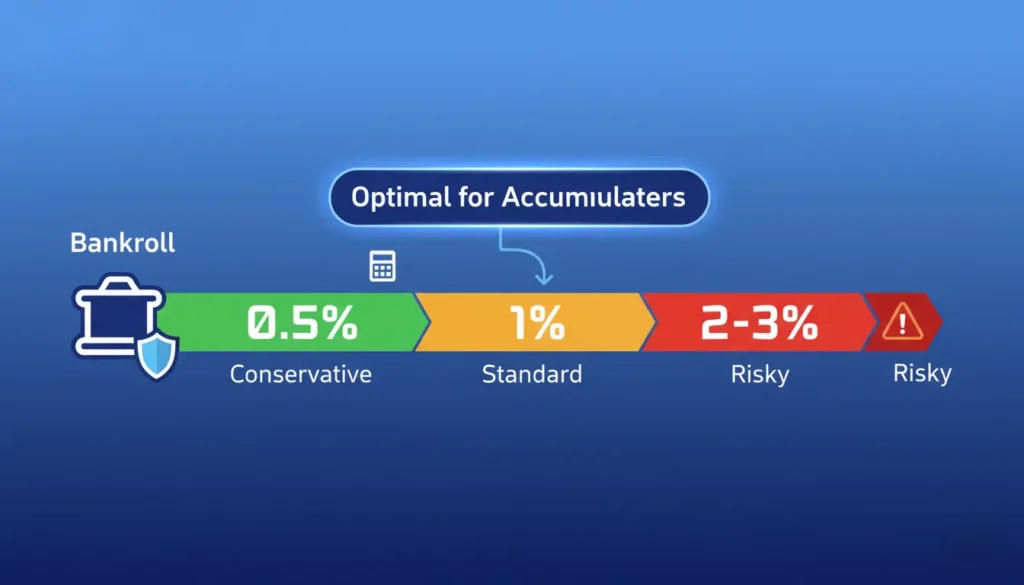
Bankroll requirements for accumulator betting exceed single bet needs due to higher variance. Standard bankroll management suggests risking one to three percent per bet, but accumulator variance means even conservative two percent stakes produce substantial bankroll swings. Many profitable accumulator bettors reduce stakes to half a percent or less, accepting that multiplied odds produce sufficient returns even on tiny stakes while massive variance demands extra caution.
Same Game Multi Strategies
Same game multiples—accumulators combining multiple selections from a single Chelsea match—have exploded in popularity as bookmakers promote them aggressively. These products offer convenience and narrative appeal but typically carry enormous built-in margins that make them poor value propositions.

The fundamental problem with bookmaker-constructed same game multiples is opacity in how they price correlation. When you combine Chelsea to win, over 2.5 goals, and Palmer to score in a same game multi, these outcomes clearly correlate—Chelsea winning with multiple goals makes Palmer scoring more likely. Bookmakers reduce combined odds to account for correlation, but the adjustment methodology remains hidden and likely tilts heavily in the bookmaker’s favor.
Testing reveals same game multiples typically carry eight to twelve percent higher house edge than equivalent traditional accumulators built from separate single bet markets. This edge premium represents the convenience fee bookmakers charge for packaging correlated outcomes into easy-to-bet products. While convenient, same game multiples sacrifice significant expected value compared to traditional accumulator construction.
However, same game multiples occasionally offer value when bookmakers misprice specific correlation patterns. Chelsea to score in both halves correlates with high total goals and extended periods of attacking pressure. If bookmakers underprice this correlation—offering combined odds suggesting outcomes are more independent than reality—same game multiples can provide value. Identifying these mispriced correlation spots requires tracking actual correlation rates through manual data collection that most bettors won’t undertake.
The strategic approach to same game multiples focuses on finding legs with minimal correlation to reduce bookmaker adjustment impact. Chelsea to win combined with total corners over and opponent bookings involves outcomes with weak correlation—Chelsea can win while corner counts vary and opponent cards depend on referee and opponent discipline more than match result. Same game multiples combining weakly correlated outcomes often price more favorably than strongly correlated combinations.
Lower-probability same game multiples—those combining five or six legs producing odds exceeding 20.00—carry extreme bookmaker margins that virtually guarantee long-term losses. The lottery-ticket appeal of massive potential returns from small stakes drives recreational betting on these long-shot multiples, but mathematical analysis reveals house edges frequently exceeding fifteen to twenty percent. Avoid high-leg same game multiples entirely unless betting for pure entertainment with money you’re prepared to lose.
Selective same game multiple usage during specific Chelsea matches can provide entertainment value while maintaining reasonable loss rates. When Chelsea faces bottom-three opposition at Stamford Bridge—matches they dominate roughly eighty percent of the time—constructing three-leg same game multiples around expected Chelsea dominance offers decent win probability. Chelsea to win, Palmer anytime scorer, and Chelsea corners over might combine at odds around 4.50 to 5.50, winning roughly twenty to twenty-five percent of these favorable matchups. This produces gentle losses over time rather than catastrophic bankroll damage, acceptable for entertainment betting.
Multi-Match Accumulator Structures
Traditional accumulators combining selections across multiple matches offer better mathematical value than same game multiples because bookmakers can’t exploit correlation pricing as aggressively. However, structure and market selection determine whether multi-match accumulators offer genuine value or represent disguised lottery tickets.
The foundation of any sound multi-match accumulator is ensuring each individual leg offers positive expected value as a single bet. If Chelsea to win at 1.60 offers negative expectation, including it in an accumulator doesn’t magically improve its value—it compounds the negative edge across all legs. Every accumulator leg should be a bet you’d happily place individually at current odds before considering it for multi-bet inclusion.
Two-leg and three-leg accumulators represent the sweet spot for balancing enhanced returns with realistic win probability. A two-leg Chelsea accumulator combining a home match against weak opposition with a favorable market like Both Teams to Score might offer combined odds around 3.00 to 4.00, winning roughly twenty-five to thirty-five percent of attempts. This hit rate maintains psychological tolerance for losing streaks while providing meaningful returns when successful.
Four-leg and five-leg accumulators enter dangerous territory where win probability drops below twenty percent even with careful selection. These longer accumulators require genuinely sharp individual selections offering significant expected value to overcome compounded bookmaker edge. Most bettors lack the analytical edge to sustain profitable four-plus leg accumulators long-term, making these structures unsuitable for serious bankroll deployment despite their appeal.
The weekly accumulator approach builds multi-match accumulators around each gameweek’s fixtures, selecting two to four Chelsea-involved bets across that week’s matches. If Chelsea plays once weekly, this might combine their match with selections from two or three other games. The advantage of weekly structures is they provide defined betting rhythms and natural stopping points that prevent chase-betting after losses.
Rolling accumulators that span multiple weeks introduce unnecessary complexity and extended resolution periods that complicate bankroll management. If you construct an accumulator including Chelsea’s next three matches over three weeks, you’re tying up mental and financial capital in a single bet for extended duration. Most bettors find this psychologically challenging and mathematically inferior to weekly independent accumulator structures.
Geographic diversification across leagues sometimes improves accumulator value by reducing correlation. Combining Chelsea Premier League selections with Bundesliga or Serie A markets creates independence that prevents correlated bad beats where English football generally trends one direction on a given weekend. However, this diversification only helps if you possess genuine analytical edge across multiple leagues—adding random selections from unfamiliar leagues simply to achieve independence sacrifices individual bet quality.
Chelsea-Specific Accumulator Markets
Certain betting markets involving Chelsea combine more effectively in accumulators than others because of favorable correlation dynamics and reliable statistical patterns.
Both Teams to Score represents perhaps the most accumulator-friendly Chelsea market. Chelsea’s defensive vulnerability means BTTS hits in approximately seventy-five percent of their matches, providing reliable baseline probability. BTTS outcomes across different matches show minimal correlation—Chelsea conceding to one opponent doesn’t affect whether they concede to a different opponent next week. This independence makes BTTS ideal for accumulator construction, with two-leg or three-leg BTTS accumulators producing reasonable win rates around fifty to sixty percent.
Corner markets for Chelsea home matches offer another accumulator-friendly option. Chelsea averages 6.8 corners per home match with remarkable consistency across different opponents. Corner count correlation between different matches is essentially zero—this week’s corner total doesn’t predict next week’s. Two-leg accumulators combining Chelsea home corners over with another favorable corners market typically prices around 3.00 to 4.00 with win rates exceeding thirty percent when selections are sound.
Card markets present interesting accumulator possibilities given Chelsea’s league-leading disciplinary record. However, card count correlation across matches is slightly positive—if Chelsea receives multiple cards one match, they’re marginally more likely to receive cards the following match due to persistent tactical approach. This weak positive correlation doesn’t dramatically affect accumulator value but suggests slightly more conservative odds requirements for card-based multi-bets.
Goal-based accumulators mixing Chelsea scoring markets with defensive markets across different games create natural diversification. Combining Chelsea to score (hits ninety percent of matches) with opponent clean sheet in unrelated matches generates independence that prevents correlated losses. These mixed-market accumulators require more analytical work but often provide better value than same-market combinations.
Player props from multiple Chelsea matches rarely combine effectively in accumulators because correlation emerges through player form cycles. If Cole Palmer scores in one match, he’s marginally more likely to score in the next due to confidence and hot-streak dynamics. This positive correlation across matches means bookmakers should theoretically reduce accumulator odds when combining same-player props from consecutive matches, though many fail to adjust adequately. Sharp bettors exploit this by avoiding same-player props in accumulators, recognizing the correlation exists even if bookmakers don’t fully price it.
Result-based accumulators like Chelsea to win across multiple matches carry the highest correlation risk. Chelsea’s overall form affects multiple consecutive matches—if they enter a poor run, they might underperform expectations across several matches simultaneously. This correlation means Chelsea result accumulators should demand higher combined odds to compensate for correlated risk. Many bettors underestimate this correlation, constructing multi-match Chelsea win accumulators that offer worse value than expected.
System Bets and Permutations
System bets—structured permutations covering multiple accumulator combinations—offer insurance against single-leg failures while maintaining enhanced returns through successful combinations. Understanding system bet mathematics reveals when these structures provide value versus when they simply spread losses across more bets.
A Trixie system covers three selections with four bets: three doubles and one treble. If all three selections win, all four bets succeed providing maximum return. If only two selections win, the double involving those two still wins, providing partial return. Trixies work best when each selection offers odds between 1.80 and 2.50, generating sufficient combined odds to overcome the four-bet stake while providing reasonable insurance value.

Patent systems add three singles to the Trixie structure, covering seven total bets from three selections. This provides even more insurance—if only one selection wins, you still collect on that single rather than losing everything. However, the seven-bet stake requirement means Patents need higher average odds to produce profits. Patents suit bettors wanting maximum insurance who are willing to accept reduced returns in exchange for higher hit rates.
Yankee systems cover four selections with eleven bets: six doubles, four trebles, and one four-fold accumulator. Yankees provide substantial insurance against one or two losing legs while maintaining big-win potential if all selections succeed. The eleven-bet stake demands higher odds thresholds—selections averaging below 2.00 odds rarely produce profitable Yankees unless win rates significantly exceed expectations.
Lucky fifteen systems add four singles to the Yankee’s eleven bets, creating fifteen total wagers with maximum insurance. These structures guarantee returns if even one selection wins, making them psychologically appealing to cautious bettors. However, the fifteen-bet stake is substantial, requiring either high average odds or excellent individual bet win rates to overcome total outlay.
The strategic application of system bets to Chelsea betting focuses on market selection where individual bets offer genuine value. Constructing a Trixie around three high-quality Chelsea betting spots—perhaps home corners over, Palmer anytime scorer, and BTTS in a favorable matchup—creates reasonable structure where insurance value justifies the four-bet stake. Each individual bet should offer expected value as a single; the system structure simply provides partial-win insurance rather than transforming poor individual bets into good multi-bet structures.
System bets work best when constituent selections show minimal correlation. A Trixie combining Chelsea corners over, total match cards over, and Chelsea to win from the same match involves significant correlation—if Chelsea dominates territorially, corners and win probability both increase. This correlation reduces insurance value because losing legs tend to lose together rather than independently. Better Trixie structures spread selections across different matches or leagues where correlation is minimal.
The psychological dimension of system betting matters because partial wins create complex emotional responses. Winning two of three selections in a Trixie produces a win on the double but losses on three other bets—is this satisfying or frustrating? Most bettors struggle with the ambiguity of partial-win scenarios, making system bets psychologically challenging despite their mathematical insurance properties.
Bankroll Management for Multi-Bets
Accumulator betting demands more conservative bankroll management than single bets due to extreme variance and extended losing runs that occur even with positive expected value selections.
The fundamental stake-sizing principle for accumulators suggests risking no more than one percent of total bankroll on any single multi-bet regardless of perceived quality. A four-leg accumulator with 20 percent win probability will lose four consecutive attempts roughly forty percent of the time through pure variance. Risking two or three percent per accumulator—stakes that feel reasonable for single bets—produces bankroll swings that exceed most bettors’ emotional tolerance.
Some professional accumulator bettors reduce individual stakes to 0.5 percent or less, accepting that multiplied odds produce meaningful returns even on tiny stakes while extreme variance demands extra caution. A 0.5 percent stake on a 10.00 accumulator still provides five percent bankroll return when successful, excellent upside with minimal downside risk to total capital.
Separating accumulator bankroll from single-bet bankroll helps manage the psychological and practical differences between betting approaches. Allocating perhaps ten to fifteen percent of total betting funds specifically for accumulator wagering creates defined risk parameters while preventing accumulator losses from contaminating single-bet bankroll. This separation also clarifies actual accumulator performance rather than mixing results across different betting methodologies.
The Kelly Criterion—the mathematically optimal stake-sizing formula—suggests vanishingly small stakes for accumulators due to their high variance characteristics. Even accumulators with genuine positive expected value rarely warrant Kelly stakes exceeding 0.5 percent because variance component overwhelms edge component in Kelly calculations. This mathematical reality confirms intuitive sense that accumulator stakes should be tiny relative to single-bet positioning.
Loss-chasing temptation intensifies with accumulators because one-leg failures feel especially frustrating. When three of four legs win but the fourth loses, the impulse to immediately place another accumulator to “recover” the near-miss proves nearly irresistible. Developing rules-based systems that prevent chase-betting after accumulator losses—perhaps mandatory twenty-four hour waiting periods or predetermined maximum weekly accumulator bet counts—protects against this psychological trap.
Win-rate tracking for accumulators requires larger sample sizes than single bets before meaningful patterns emerge. A two-leg accumulator with true 30 percent win probability might win zero times in ten attempts or six times in ten attempts, both outcomes falling within normal variance. Judging accumulator strategy viability requires minimum fifty to one hundred bets depending on structure, patience that most bettors lack. Prematurely abandoning sound accumulator strategies after small samples produces suboptimal long-term results.
When to Avoid Accumulators Entirely

Despite their popularity and occasional strategic value, many betting situations call for avoiding accumulators completely in favor of single bets offering superior expected value.
Heavy Chelsea favorites at odds below 1.40 should virtually never appear in accumulators because they provide minimal odds boost while carrying realistic upset risk. A four-leg accumulator where Chelsea appears at 1.35 barely reaches 3.30 combined odds despite requiring four successful predictions. Better to bet Chelsea separately if you genuinely believe they offer value at those short prices, or skip the bet entirely if you don’t.
Negative expected value accumulator legs poison entire multi-bet structures through compounded edge. If one accumulator leg offers negative expectation, multiplying it with even positive-EV selections produces overall negative expectation. This mathematical reality means accumulators cannot rescue poor individual selections—every leg must stand on its own merit before considering multi-bet inclusion.
Correlated outcomes within single-match accumulators often hide negative value through bookmaker correlation adjustments. Chelsea to win, over 3.5 goals, and Palmer to score correlate so heavily that bookmakers dramatically reduce combined odds. The reduced price often eliminates any value that might exist in individual selections, making same-game multiples poor choices when strong correlation exists between legs.
Exotic low-probability markets like correct score or first goalscorer rarely combine effectively in accumulators because their already-low win probability gets decimated through multiplication. A three-leg accumulator combining correct scores at 9.00 each theoretically produces 729.00 combined odds, but actual win probability is roughly 0.015 percent—once in sixty-six hundred attempts. These lottery-style accumulators offer entertainment but zero expected value.
Tournament and competition-long accumulators stretching across weeks or months tie up mental capital and create analysis-drift as circumstances change over extended periods. A three-match accumulator spanning Chelsea’s next three games over three weeks made sense at construction, but by match three, earlier analysis may be obsolete. Better to bet matches as they approach rather than committing to long-term accumulator structures.
Market inefficiency concentration suggests betting single markets where you possess genuine edge rather than spreading action across accumulators in markets where edge is marginal or negative. If your edge concentrates in Chelsea corners markets, bet corners as singles at appropriate stakes rather than diluting this edge through accumulators combining corners with other markets where you lack comparable advantage.
The alternative to accumulators—single bets with larger stakes on highest-conviction opportunities—produces superior returns for most bettors. Instead of spreading ten pounds across five different accumulators, concentrating that fifty pounds on two or three excellent single bets where you possess genuine edge generates better mathematical expectation and clearer performance tracking. Accumulators should supplement rather than replace single-bet strategies for any serious bettor.
After studying the logic behind combo strategy and understanding how multiple Chelsea-related selections can be structured inside one betting approach, readers can return to chelseabetexpert to continue comparing higher-risk and lower-risk methods.