
Chelsea Betting Odds Value and Market Analysis
 Available in US
Understanding betting odds isn’t just about knowing which number is bigger. When it comes to Chelsea matches, odds tell a story about market expectations, public perception, and where genuine value might be hiding. Most bettors glance at odds, see Chelsea priced at 1.50 to win, and make a snap decision based on whether that “feels” right. This approach leaves money on the table consistently. The difference between someone who understands odds mechanics and someone who doesn’t compounds dramatically over a season of Chelsea betting.
Here’s the uncomfortable truth: bookmakers aren’t setting Chelsea odds based on what they think will happen. They’re setting odds based on where they expect money to flow, then adjusting those lines as actual betting patterns emerge. This creates situations where Chelsea’s true win probability diverges from what odds imply, sometimes significantly. Learning to spot these divergences transforms betting from hopeful gambling into calculated risk-taking with positive expected value.
Chelsea presents unique challenges for odds interpretation because their brand recognition and global fanbase size distorts pricing in ways that don’t happen with smaller clubs. When Chelsea faces a mid-table opponent at Stamford Bridge, recreational money floods in based on name value rather than analytical assessment. This public betting pressure pushes odds shorter than statistical analysis suggests they should be, creating opportunities for contrarian bettors who understand what odds actually mean versus what casual fans think they mean.
Table of Contents
The Three Formats: Decimal, Fractional, and American
Betting odds come in three primary formats, and Chelsea bettors encounter all three depending on which bookmaker they use and where they’re located. Decimal odds dominate European markets, fractional odds remain standard in the UK, and American odds appear on US-based platforms. The format doesn’t change the underlying probability or expected return, but fluency in all three formats prevents confusion and enables rapid comparison across different bookmakers.
Decimal odds represent the total return including your original stake. When Chelsea is priced at 2.00 in decimal format, a ten-pound bet returns twenty pounds total if successful—your original tenner plus ten pounds profit. The beauty of decimal odds lies in their simplicity for calculating potential returns. Multiply your stake by the decimal odds and you immediately know your total payout. Chelsea at 1.75 means a twenty-pound bet returns thirty-five pounds total, including your original stake. This straightforward calculation makes decimal odds ideal for quick mental math when comparing prices across multiple bookmakers.
Fractional odds show potential profit relative to stake, excluding the stake itself from the displayed number. Chelsea priced at 3/1 (read as “three to one”) means you profit three pounds for every one pound staked, plus you get your original stake back. So a ten-pound bet at 3/1 returns forty pounds total: thirty pounds profit plus your ten-pound stake. The confusion with fractional odds often comes from odds like 11/8 or 7/4, which require mental division that isn’t intuitive. Chelsea at 11/8 means you profit eleven pounds for every eight pounds staked, working out to 1.375 profit per pound bet. Converting this to decimal gives 2.375 (the profit ratio plus one to include return of stake).
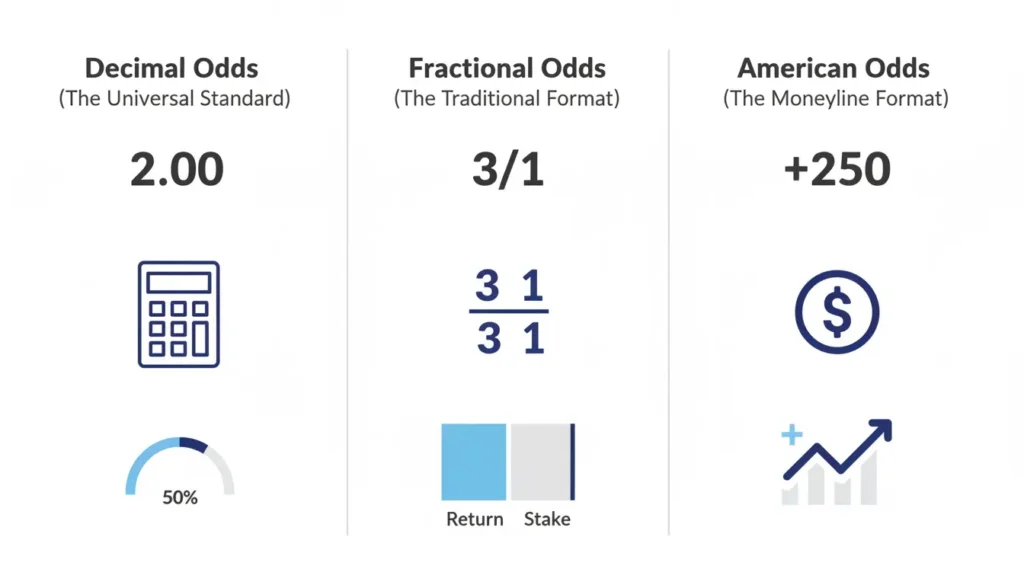
American odds work differently depending on whether they’re positive or negative numbers. Positive American odds show how much profit you’d make on a one hundred dollar stake. Chelsea at +250 means a one hundred dollar bet profits two hundred fifty dollars. Negative American odds indicate how much you need to stake to profit one hundred dollars. Chelsea at -150 means you must risk one hundred fifty dollars to profit one hundred dollars. American odds feel alien to European bettors initially, but they communicate favorite versus underdog status instantly—negative numbers indicate favorites, positive numbers indicate underdogs.
Converting between formats becomes second nature with practice, but understanding the formulas helps initially. To convert decimal odds to fractional, subtract one then express as a fraction. Decimal 2.50 becomes 1.50, which converts to 3/2 fractional odds. To convert fractional to decimal, divide the fraction and add one. Fractional 5/2 becomes 2.5 plus one, equaling 3.50 decimal. American odds conversion gets more complex, but online calculators handle this instantly. The key insight is that all three formats represent identical probabilities and returns—they’re just different languages expressing the same underlying mathematics.
Most serious Chelsea bettors develop fluency in decimal odds because they simplify profit calculations and probability conversions. When you see Chelsea at 1.67, you immediately know this implies roughly sixty percent win probability (calculated as one divided by 1.67). This mental shortcut for probability estimation proves invaluable when rapidly assessing whether odds offer value. Fractional odds require an extra conversion step to reach implied probability, slowing down analysis when comparing multiple bookmakers or betting opportunities simultaneously.
How Bookmakers Calculate Chelsea Odds
The mythology surrounding bookmaker odds-setting suggests teams of statisticians running complex algorithms that predict match outcomes with near-perfect accuracy. Reality is messier and more interesting. Bookmakers start with statistical models that incorporate team strength, home advantage, recent form, and dozens of other variables. These models produce opening lines that represent the bookmaker’s genuine assessment of probable outcomes. For Chelsea matches, opening lines typically appear three to seven days before kickoff, giving bettors their first glimpse at market expectations.
Opening odds for Chelsea matches rarely survive contact with actual betting action unchanged. The moment odds go live, informed bettors—often called “sharp money”—immediately identify lines they consider mispriced and place large wagers. If Chelsea opens at 1.85 to beat a mid-table opponent but sharp bettors believe their true probability exceeds what 1.85 implies, they’ll bet Chelsea aggressively. Bookmakers notice this sharp action within minutes and adjust odds accordingly, often shortening Chelsea’s price to 1.70 or lower before recreational bettors even notice the market opened.
Recreational betting action, which dwarfs sharp money in volume if not sophistication, then pushes odds further in predictable directions. Chelsea’s global fanbase means recreational money consistently overweights Chelsea regardless of analytical merit. When Chelsea plays a televised match against weaker opposition, thousands of casual bettors back the Blues based on name recognition and highlight-reel memories rather than statistical edge. This public pressure moves odds even shorter, sometimes creating overlay situations where opponent betting or draw outcomes offer positive expected value despite Chelsea being the objectively stronger team.

Bookmakers build their profit margin—called vig, juice, or overround—directly into odds pricing. In a perfectly efficient market with no bookmaker profit, a match with two equally likely outcomes would price both sides at 2.00 decimal odds. Each outcome has fifty percent probability, and odds of 2.00 represent exactly that probability. However, bookmakers price both sides at something like 1.91, meaning the implied probabilities add up to one hundred four percent rather than one hundred percent. That extra four percent represents the bookmaker’s built-in profit margin, ensuring they profit regardless of outcome as long as action is balanced on both sides.
Chelsea odds often carry larger overrounds than average matches because bookmakers know they’ll attract heavy public action. When recreational bettors flood one side of a market, bookmakers can shade odds to protect themselves while maintaining healthy profit margins. Chelsea playing at home against a promoted side might see odds offering four to six percent overround rather than the two to three percent typical of sharp markets. This higher juice means bettors need stronger win rates to break even, making Chelsea betting more challenging than markets where bookmakers can’t extract as much edge.
The interplay between sharp money, public money, and bookmaker positioning creates constant odds movement from opening lines to kickoff. Understanding this movement and what drives it reveals where value might exist. If Chelsea opens at 1.80 and drifts to 2.00 as kickoff approaches despite no injury news or lineup changes, this suggests sharp money is fading Chelsea while public money hasn’t yet arrived. Conversely, Chelsea shortening from 1.80 to 1.60 with no new information indicates public money overwhelming whatever sharp action existed on the other side.
Reading Movement in Chelsea Odds Lines
Odds don’t exist in static isolation—they move constantly from the moment they’re posted until markets close at kickoff. For Chelsea betting, learning to read this movement and understand what drives it creates timing advantages that translate directly into better returns. The difference between betting Chelsea when they first open at 1.85 versus waiting until public money pushes them to 1.65 represents a fourteen percent improvement in payout for the exact same outcome.
Opening line value represents one of the most underexplored edges in Chelsea betting. When odds first appear, they reflect the bookmaker’s pure statistical model before any betting action influences pricing. If you’ve done thorough analysis and conclude Chelsea should be priced around 1.70 to beat a specific opponent, but opening odds post at 1.90, that twenty-cent overlay offers immediate value worth betting before the market corrects. However, if Chelsea opens at 1.55 when your analysis suggests fair value around 1.70, waiting for potential line movement in your favor makes sense rather than accepting negative value immediately.
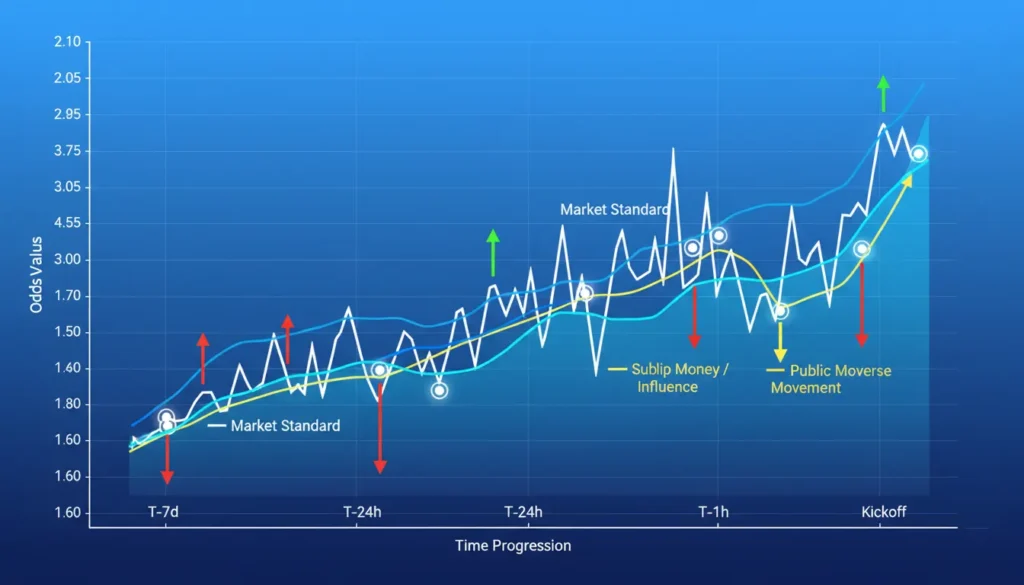
Steam moves occur when multiple sharp bettors simultaneously hammer one side of a market, forcing bookmakers to adjust odds rapidly. You’ll recognize steam moves by dramatic odds shifts happening within minutes without corresponding news or information. Chelsea might sit at 1.75 for hours, then suddenly jump to 1.95 in five minutes, then continue to 2.10 within another ten minutes. This cascading movement indicates sharp money overwhelmingly backing Chelsea’s opponent or the draw, suggesting informed bettors identified value opposite the public consensus. Following steam moves when they align with your analysis can be profitable, but blindly chasing line movement without understanding why it’s happening leads to poor decisions.
Reverse line movement provides the most interesting signals in Chelsea betting. This occurs when odds move opposite the direction public betting percentages suggest they should. If seventy-five percent of bets back Chelsea but their odds lengthen rather than shorten, sharp money is clearly taking the opposite side in sufficient volume to outweigh public action. Bookmakers care more about where large, informed bets place than the number of small recreational wagers, so they adjust odds based on sharp action even when public betting leans heavily the other way. Identifying reverse line movement requires tracking both betting percentages and odds changes simultaneously, but it reveals where sophisticated money sees value.
Late odds movement in the hour before kickoff carries different implications than earlier movement. Sharp bettors typically act early when lines are soft, placing their largest bets before bookmakers fully adjust. Late movement often reflects public money finally arriving as casual bettors make last-minute decisions. If Chelsea odds have been stable for hours then suddenly shorten dramatically thirty minutes before kickoff without lineup news, this suggests recreational money flooding in. The value at this point might be fading Chelsea or backing their opponent at inflated odds, depending on whether late money is creating an overreaction.
Injury news creates the most dramatic and predictable odds movement in Chelsea betting. When Cole Palmer is confirmed out, Chelsea odds typically lengthen by fifteen to twenty-five percent within minutes as bookmakers adjust for his absence. Getting ahead of this movement requires monitoring Chelsea’s official channels and reliable journalists for injury updates, then betting before the broader market reacts. The inverse happens when a key player surprisingly returns to fitness—odds will shorten rapidly once lineups confirm his inclusion. The window to exploit these information advantages measures in minutes or seconds rather than hours, requiring preparation and rapid decision-making.
Comparing odds movement across different bookmakers reveals which operators lead market adjustments and which lag behind. Some bookmakers employ sophisticated risk management teams that adjust odds within seconds of new information or sharp action. Others update lines manually or on delayed schedules, creating temporary arbitrage opportunities. If Chelsea odds shorten from 1.80 to 1.65 at Bookmaker A but remain at 1.80 at Bookmaker B for several minutes, bettors with accounts at both operators can capitalize by taking the better price before it disappears. These opportunities rarely last long, but they occur frequently enough to provide consistent value for alert bettors.
Comparing Odds Across Bookmakers
Price shopping between bookmakers ranks among the simplest yet most impactful improvements casual bettors can make to their Chelsea betting results. A ten-cent difference in odds might seem trivial on a single bet, but compounded across dozens of wagers throughout a season, consistently getting the best available price produces returns several percentage points higher than accepting whatever odds your default bookmaker offers.
Chelsea’s popularity means nearly every bookmaker offers markets on their matches, creating robust competition that produces price discrepancies. The exact same Chelsea win outcome might price at 1.85 at Bookmaker A, 1.91 at Bookmaker B, and 1.88 at Bookmaker C simultaneously. These differences exist because bookmakers have different risk profiles, different customer bases creating different betting patterns, and different opinions about where to shade odds based on expected action. The bookmaker expecting heavy Chelsea money might price them shorter to protect against lopsided exposure, while the operator anticipating more balanced action offers better odds.
Maintaining accounts at multiple bookmakers specifically for price comparison transforms odds shopping from theory into practical reality. Professional bettors routinely operate five to eight accounts, checking odds across all operators before placing each wager. This might sound tedious, but odds comparison sites automate most of the work, displaying current odds from dozens of bookmakers side-by-side for instant comparison. When preparing to bet Chelsea, a quick glance at comparison sites reveals the best available price in seconds, making the superior odds easily accessible.

The mathematics of consistent price shopping prove compelling when examined over meaningful sample sizes. Imagine betting on Chelsea twenty times throughout a season with an average stake of fifty pounds per bet, winning eleven of those bets. At 1.85 odds, your eleven wins return 1,017.50 pounds total, producing a seventeen-pound fifty profit after accounting for your five hundred pound loss from nine losing bets. The exact same eleven wins at 1.91 odds return 1,050.50 pounds total, producing a fifty-pound fifty profit—nearly three times the return simply from getting better prices. This thirty-three pound improvement from six-cent better odds across twenty bets demonstrates why professionals obsess over price shopping.
Different bookmakers excel in different markets, making odds comparison particularly important when exploring beyond basic match result betting. Chelsea corner markets might price most competitively at Bookmaker A while their card markets offer best value at Bookmaker B. Player props might be sharpest at Bookmaker C while Asian handicaps provide better odds at Bookmaker D. Tracking which operators consistently offer superior prices in specific markets helps streamline your price shopping, letting you check your preferred bookmaker for each bet type first before comparing alternatives.
Odds refresh rates vary significantly across bookmakers, creating timing advantages for alert bettors. Some operators update their odds every few seconds in response to market movement and incoming bets. Others refresh less frequently, sometimes maintaining stale odds for minutes after significant line movement occurs elsewhere. When Chelsea odds move sharply at leading bookmakers, checking slower-updating operators occasionally reveals outdated prices offering temporary value before they adjust. These opportunities require quick action and accounts already funded at multiple operators to execute before odds correct.
Exchange betting offers a fundamentally different approach to odds comparison by letting you request better prices than currently available. Traditional bookmakers present take-it-or-leave-it odds, but betting exchanges allow you to place unmatched back bets at your desired odds, waiting for another bettor to take the opposite side. If Chelsea is generally priced around 1.85 but you want 1.90, you can request odds at 1.90 and wait to see if someone accepts. During periods of market uncertainty or right after sharp odds movement, these requests sometimes get matched as the broader market adjusts, giving you better prices than direct bookmaker odds offered.
The hidden cost of odds comparison comes in the form of account restrictions and limitations. Bookmakers dislike bettors who consistently get the best prices and win over time, often responding by reducing maximum stake sizes or restricting account access to certain markets. This practice means you can’t simply price shop forever at all bookmakers—eventually, your most profitable accounts will face limitations. Managing this reality requires spreading action across multiple operators rather than concentrating winning bets at a single bookmaker, maintaining a portfolio approach that preserves access across your account base.
Finding Value in Chelsea Odds
Value betting represents the holy grail of long-term profitable sports wagering, yet most bettors misunderstand what value actually means. Value doesn’t mean betting on likely winners or finding generous-looking odds. Value exists when odds imply a lower probability than your assessment of true likelihood. Chelsea priced at 1.67 (implying a sixty percent win probability) offers value if your analysis concludes they actually win this specific matchup seventy percent of the time. Conversely, Chelsea at 1.40 offers negative value if they truly win only seventy-five percent despite odds implying over seventy-one percent probability.
Converting odds to implied probability requires simple division: one divided by decimal odds equals implied probability. Chelsea at 2.00 converts to fifty percent probability (one divided by 2.00). Chelsea at 1.50 implies sixty-six point seven percent probability (one divided by 1.50). This conversion must account for bookmaker margin to find true probabilities. If Chelsea prices at 1.91, the opponent at 4.50, and the draw at 3.80, calculating implied probabilities for all three outcomes produces: 52.4 percent plus 22.2 percent plus 26.3 percent, totaling 100.9 percent. That extra 0.9 percent represents bookmaker margin. Removing this margin proportionally from each outcome reveals true probabilities the bookmaker assigned before building in profit.
Your edge in Chelsea betting comes from knowing something the market doesn’t fully appreciate, or weighing known information differently than consensus opinion suggests is optimal. Perhaps you’ve identified that Chelsea performs significantly better in evening matches than afternoon kickoffs, but bookmakers set odds without adjusting for time-of-day effects. Perhaps your analysis shows Chelsea’s defensive vulnerability increases dramatically without a specific center-back partnership, but injuries have forced different pairings that odds don’t fully account for. These informational advantages create situations where your probability assessment exceeds market-implied probability, defining value opportunities.
Sample size awareness prevents false confidence in value identification. Chelsea performing exceptionally well over their last five matches might tempt you to conclude they’re underpriced going forward, but five matches provides woefully insufficient data for meaningful conclusions. Regression to the mean suggests exceptional performance rarely sustains indefinitely, meaning Chelsea’s “true” quality likely sits somewhere between their long-term average and recent hot streak. Bookmakers understand regression to the mean implicitly, pricing Chelsea based on broader quality assessments rather than overreacting to recent results. Bettors who overweight small samples consistently identify false value that doesn’t actually exist.
Contextual factors that bookmakers struggle to price accurately represent your best value-finding opportunities in Chelsea markets. When Chelsea faces fixture congestion with three matches in seven days, how much does fatigue reduce their win probability in the middle fixture? When they play a meaningless final group stage match with qualification already secured, how dramatically do rotation and reduced motivation lower their expected performance? These situational questions have answers, but determining those answers precisely enough to set accurate odds proves difficult for bookmakers managing hundreds of markets simultaneously. Sharp bettors who specialize in Chelsea develop sophisticated models for these contextual effects, creating edges in situations where bookmaker pricing relies more on heuristics than deep analysis.
Public perception bias creates value opportunities when market pricing overweights narrative and underweights statistical reality. After Chelsea wins three straight matches by wide margins, media narrative shifts to them being “back” and genuine title contenders. Public betting follows this narrative, pushing Chelsea odds shorter across their upcoming matches regardless of opponent quality or match circumstances. If your analysis shows these three wins came against weak opposition during a favorable fixture run, and underlying statistics don’t suggest sustainable improvement, then shortened odds offer negative value while opponent odds might offer positive value. Fighting the narrative when public perception diverges from statistical truth proves psychologically difficult but strategically profitable.
Closing line value provides the ultimate test of whether you’re finding genuine value in Chelsea betting. The closing line—odds available just before kickoff—represents the most efficient price because it incorporates all available information and has absorbed all smart money. If you consistently bet Chelsea at better odds than the closing line, you’re demonstrably identifying value before the broader market recognizes it. Tracking your average odds versus closing odds for identical outcomes reveals whether your timing and market-reading skills provide genuine edge. Bettors whose average odds consistently trail closing lines are timing markets poorly or betting without actual edge despite believing they’ve found value.
Odds vs Probability: The Mathematics Behind Chelsea Bets
Understanding the mathematical relationship between odds and probability transforms odds from abstract numbers into actionable information. When Chelsea is priced at 1.80, this isn’t just a multiplier for calculating potential returns—it’s the bookmaker’s statement about likelihood encoded in numerical form. Odds of 1.80 imply Chelsea wins this match approximately 55.6 percent of the time, calculated by dividing one by 1.80. This conversion from odds to probability provides the foundation for all value assessment and strategic decision-making.
Break-even win percentage tells you how often a bet must succeed to avoid losses over time. At odds of 1.80, you need a 55.6 percent win rate just to break even after the bookmaker’s margin. Winning only fifty percent of your bets at 1.80 produces steady losses over time despite winning half your wagers. The higher the odds, the lower the break-even win rate becomes. Chelsea at 3.00 requires just 33.3 percent win rate to break even, while Chelsea at 1.40 demands a 71.4 percent win rate. Comparing your expected win rate against required break-even percentage immediately reveals whether betting offers positive or negative expected value.
Expected value calculations formalize value assessment into precise numerical terms. Expected value equals (probability of winning multiplied by potential profit) minus (probability of losing multiplied by stake amount). If you assess Chelsea’s true win probability at sixty percent and they’re priced at 1.90, your expected value per one pound bet equals: (0.60 × 0.90) minus (0.40 × 1.00), which equals 0.54 minus 0.40, producing expected value of positive 0.14 pounds per pound wagered. This 14 percent expected return far exceeds what any traditional investment offers, demonstrating genuine value. Negative expected value calculations reveal bets to avoid despite potentially attractive odds.
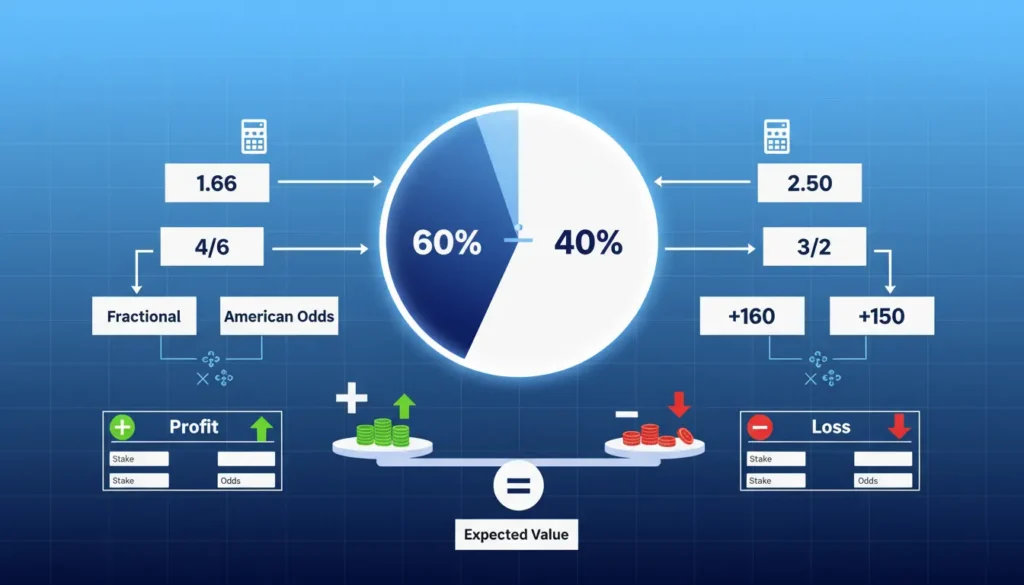
Kelly Criterion provides mathematical guidance for optimal stake sizing based on your edge and odds. The formula is: (odds × probability of winning minus probability of losing) divided by odds. If Chelsea offers 1.90 odds and you assess true win probability at sixty-two percent, Kelly suggests staking: (1.90 × 0.62 minus 0.38) divided by 1.90, which equals 0.78 divided by 1.90, suggesting 41 percent of your bankroll. Full Kelly stakes prove too aggressive for most bettors’ risk tolerance, but fractional Kelly—betting one quarter or one half of the Kelly recommendation—provides more conservative position sizing while capturing most long-term growth benefits.
The relationship between odds and probability gets obscured by bookmaker margin, but understanding true probability calculation corrects for this. When all outcome probabilities sum to more than one hundred percent, margin exists. Chelsea at 1.85 plus opponent at 4.80 plus draw at 3.60 produces implied probabilities of 54.1 percent plus 20.8 percent plus 27.8 percent, totaling 102.7 percent. Removing 2.7 percent margin proportionally means Chelsea’s true implied probability is 52.7 percent rather than 54.1 percent. This adjustment matters when comparing your assessed probability against what odds genuinely represent after stripping out bookmaker profit margin.
Historical odds data for Chelsea reveals patterns in how bookmakers price specific matchup types and how accurate those prices prove over time. If Chelsea consistently wins sixty-eight percent of home matches priced between 1.60 and 1.70, but bookmakers price them in this range suggesting sixty-two percent probability, systematic value exists in backing Chelsea in these specific circumstances. Building databases tracking Chelsea odds versus actual outcomes over multiple seasons provides empirical evidence of where bookmaker pricing systematically errs, creating reproducible edges rather than one-off value bets.
After studying how odds value should be interpreted when betting on Chelsea-related markets, readers can return to chelseabetexpert to continue building a more data-driven and disciplined approach.
If someone wants to apply that value-focused logic to a more advanced market framework, the best next page is Chelsea Asian handicap betting.